Jahazi

Jahazi

Introduction

"If you want to build a ship, don't drum up people to collect wood and don't assign them tasks and work, but rather teach them to long for the endless immensity of the sea"
Antoine de Saint-Exupery

With that in mind one may think that anybody with a passion for the sea can build an ocean going yacht. But be warned! It is not something that can be taken lightly. It takes time and dedication.This project was started in 2004 with the purchase of plans for the Didi 34. Although almost finished, it is still ongoing.
Showing posts with label Bulkheads. Show all posts

Tuesday, 31 January 2006

Setting up the bulkheads (2006)

After completion of all the bulkheads, it was time to set them up on a strongback. I started with the construction of the strongback during January 2006. It was constructed out of pine rafters fixed to pine posts cemented in concrete. The strongback must provide a stable platform onto which the bulkheads can be set up in their respective positions, plump and perpendicular to each other. At the same time a tarpaulin roof was made to protect all future building from sun and rain. Luckily the construction area was fairly well protected from wind.
I started with bulkhead A. At this stage one of those laser levels is a handy piece of equipment to have. When mounted on a tripod one can easily line up all bulkheads with the level. A plump line was used to ensure each was vertically set up according to the center-line. It took 90 man hours to build the strongback and set up all the bulkheads.

PS, Through time I have experienced the difficulties, or should I rather say, the problems one encounters when building a boat outside. Without a proper enclosure one is always exposed to the elements. It being too hot or too cold, windy and wet, or just plain unpleasant. Furthermore, epoxy is sensitive to high and low temperatures and during the curing process does not like moisture. Water discolours wood and must be kept away from the untreated panels. These are all factors that influence the speed of the building process.

The strongback.
Bulkhead A installed.
Bulkhead B. Note the plump line on center-line.
Bulkhead C from a different view.
Note center-line.
Two more to go.

Sunday, 1 August 2004

The first steps (2004-2005)

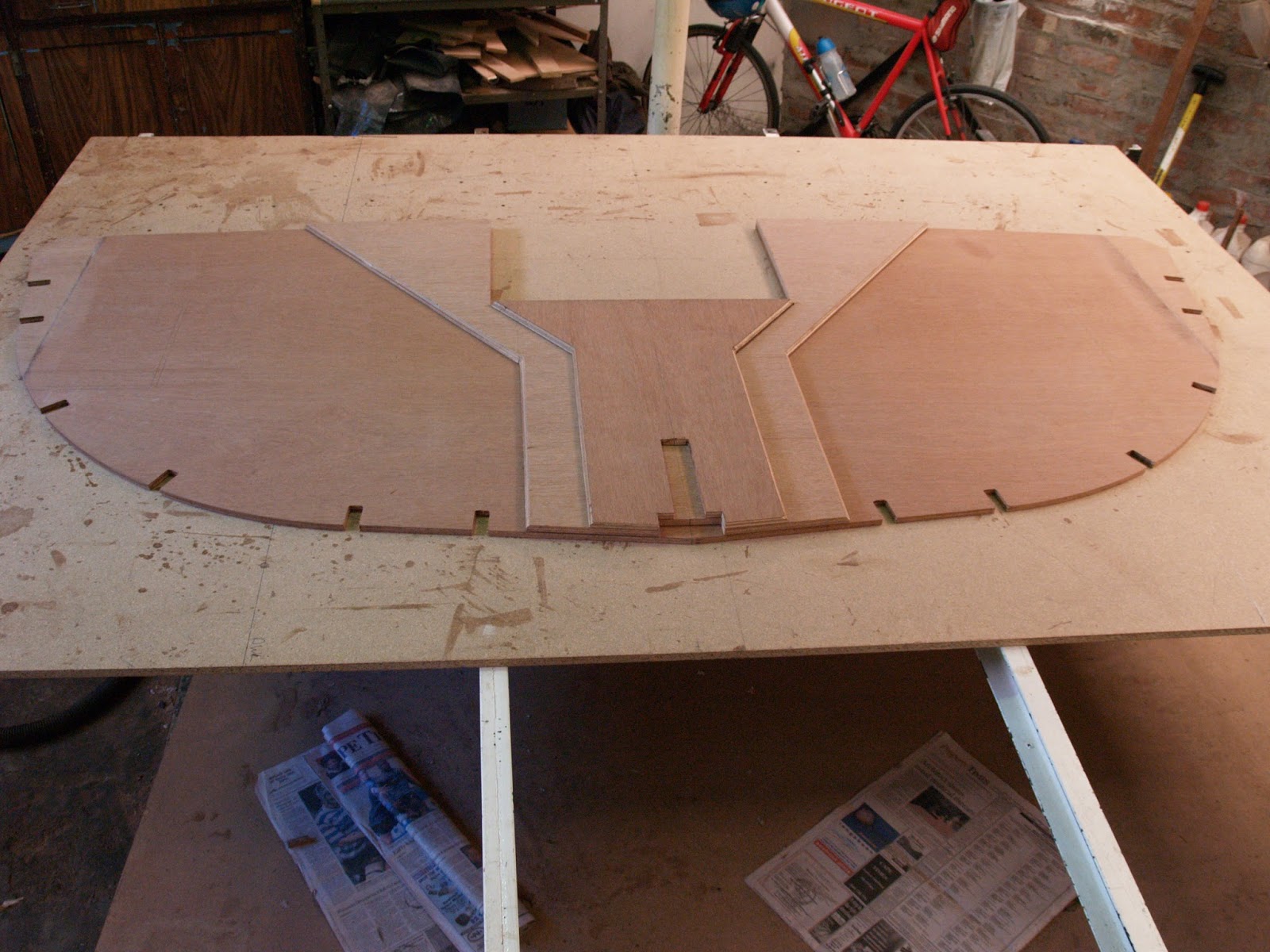
The building plans arrived April 2004. The first step  was to transfer the bulkhead measurements to the marine ply panels and to cut the bulkheads. I had to construct a working table large enough to hold the largest bulkhead, something that was absolutely worthwhile. Working on a floor surface is a backbreaking experience. So, my first suggestion to prospective boat builders would be to construct a working table.
Some bulkheads are 9 mm thick while others are of 12 mm thickness. The larger bulkheads are bigger than a standard 1.2 x 2.4 plywood panel. Therefore a woodworking technique that needs to be learned right at the start, is the scarfing of plywood.
Cutting the bulkheads is easy if one makes use of a router with a 6 mm bit. The strait lines can be cut using a straight edge as guide while the curves can be cut using the router's own guide with center pin. I found it very difficult to cut nice smooth and straight lines with a jigsaw, even after a number of years practice. On the other hand, the router produces a very smooth and accurate cut.
By the end of 2005 all 9 bulkheads were finished and ready for setup. It took 374 man hours to get to this stage.


Stern bulkhead with reinforcement at the rudder area.
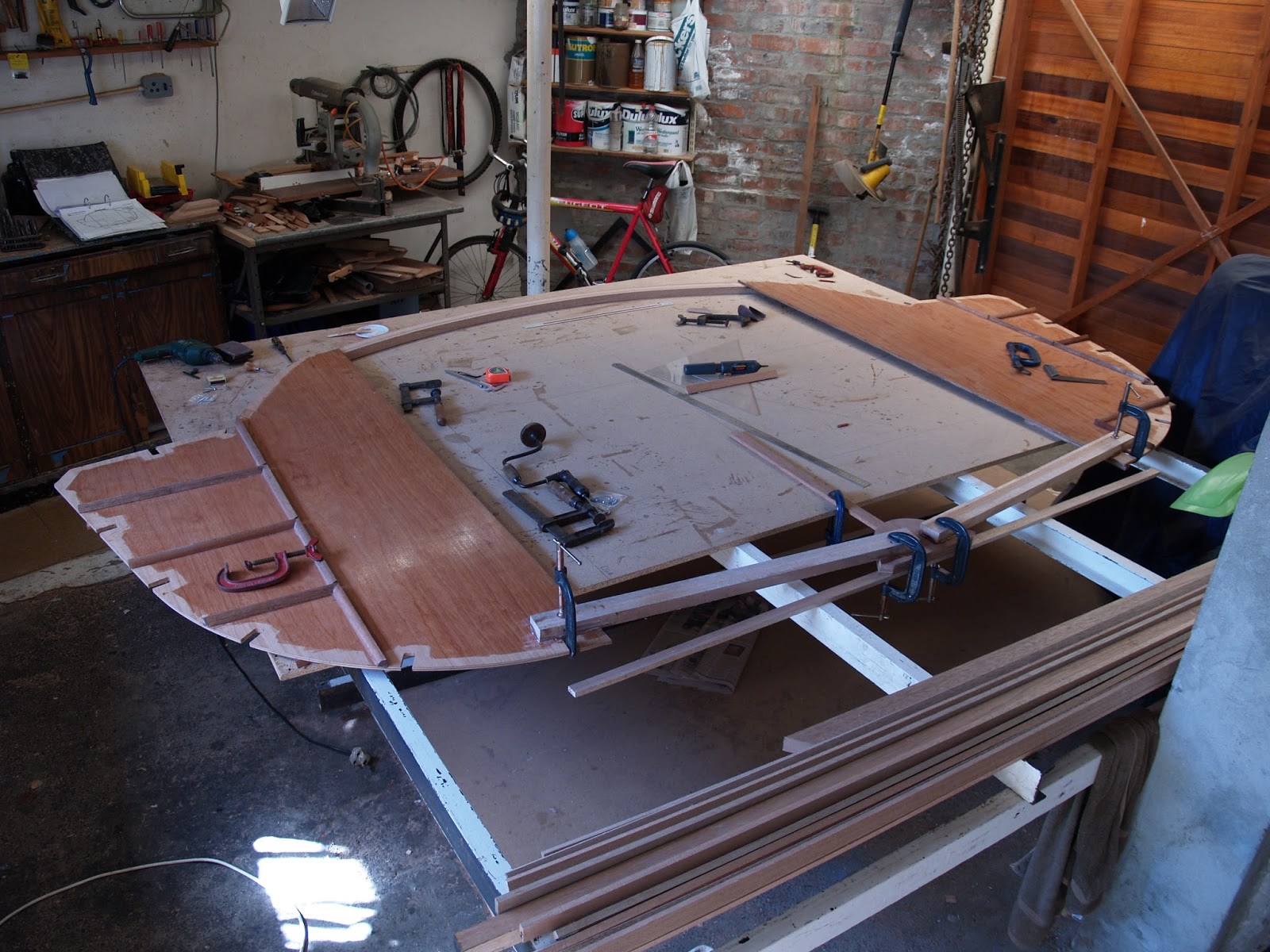
A bulkhead build out of separate panels connected by laminated beams.

Finished bulkhead, coated with epoxy and ready for setup. Notice cleats for interior construction. 

Bulkheads ready for setup.